This October, Yerevan becomes the center of the world’s efforts to save nature. From 18 to 30 October 2026, the Armenian capital hosts COP17, the seventeenth Conference of the Parties to the UN Convention on Biological Diversity, drawing delegations from nearly 200 countries under the banner “Taking action for nature.” It is the first global stocktake of the Kunming-Montreal Global Biodiversity Framework, the landmark 2022 deal that committed the world to protecting 30% of land and sea by 2030. For Armenia, a country losing roughly 110 hectares of forest every year to logging, grazing and mining, the summit is a chance, in the words of the UN’s resident coordinator, to become a benchmark for biodiversity.
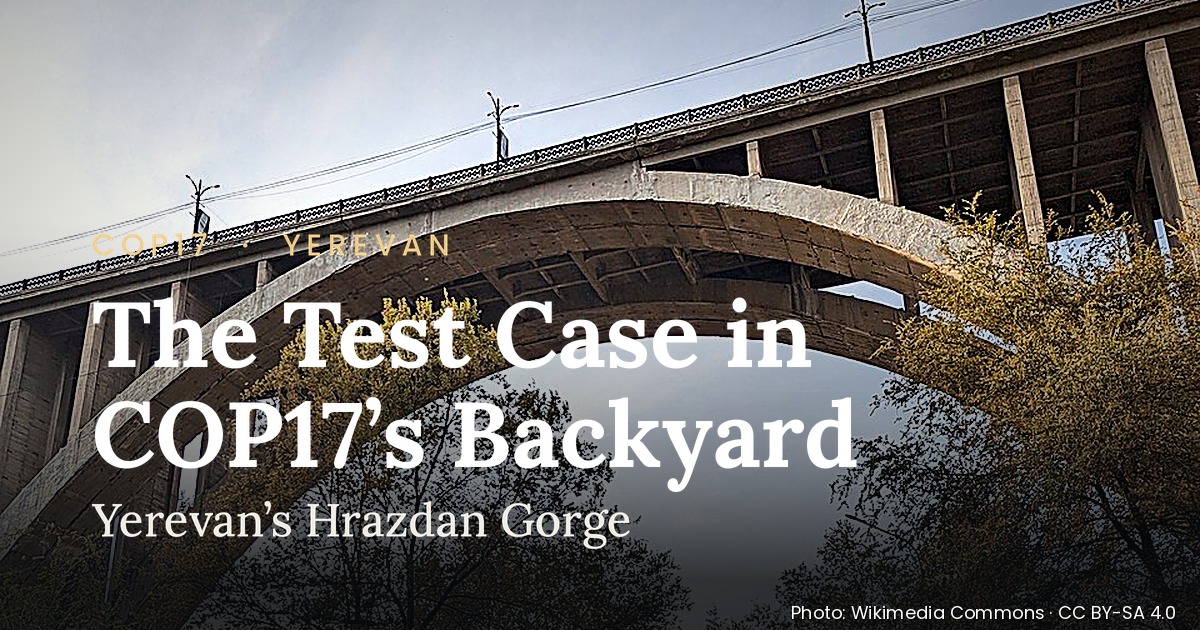
One site that is needed to be protected runs right through the host city. It is the Hrazdan Gorge: a deep green ravine that cuts across Yerevan.For decades it has been treated as leftover space, half-wild, half-dumped-on. Now, on the eve of COP17, it is being reimagined as the country’s first municipally protected natural area. Botanists classify the surrounding area as the Yerevan Floristic Region, home to roughly 1,920 plant species, 46 grow nowhere else on Earth and 144 are listed in Armenia’s Red Book.
The gorge is the city’s living artery. Its banks carry classic wetland vegetation, reed, bulrush and sedge, alongside sea-buckthorn, pine and poplar, and that structure makes it a magnet for wildlife. Birdwatchers regularly log Syrian woodpeckers, common and alpine swifts, cuckoos and turtle doves, while the river and the nearby Yerevan Lake draw herons, gulls, storks, grebes and terns. The gorge’s most surprising residents, though, are cold-blooded. For a capital city, Yerevan’s reptile diversity is remarkable: some 25 reptile species occur within the urban area, from the Levantine viper and Levant skink to whip snakes and the spur-thighed tortoise. Nationally, Armenia is a global center of reptile diversity, with 53 species, many endemic to the Armenian Highland, including the famous all-female “parthenogenetic” rock lizards that reproduce without males. And then there is the crown jewel. On Yerevan’s south-eastern edge, the tiny 120-hectare Erebuni State Reserve protects something of planetary value: the wild ancestors of cultivated wheat.
The gorge’s moment Yerevan’s municipality is preparing to designate the entire gorge as a specially protected community area. Under Armenian law, that status legally obliges the city to produce a management plan, which is what converts good intentions into binding action. Backed by the Asian Development Bank, the city is drawing up that plan alongside biodiversity and environmental assessments, as part of a wider vision to turn the gorge and Yerevan Lake into a climate-resilient blue-green corridor. The protected area is due to be defined and its management plan developed by 2027, with a first phase of works by 2030.
Practical measures are already on the list: cleaning the heavily polluted river — where sampling has repeatedly exceeded safe limits for nitrates, ammonium and heavy metals such as aluminium, copper and chromium installing river litter traps, building water treatment, and mapping every tree and shrub in the city into a database so that green cover can actually be tracked and defended. In 2025, Yerevan joined the International Union for Conservation of Nature as a subnational member, plugging the city into global conservation expertise. And Armenia’s new national biodiversity targets for 2026–2030 explicitly call for expanding urban green space, aiming to add at least two square meters of green area per resident.
Lessons from elsewhere Yerevan does not have to guess. Cities and conservationists around the world have already run versions of this experiment, and their results point the way. Geneva’s Aire shows restoration can honour history. Faced with a canalised river and a dilemma close to Yerevan’s, Geneva’s award-winning renaturation let a new river meander through a sculpted landscape while deliberately preserving the old straight canal alongside it as a cultural marker. Fish returned; a hugely popular park was born. It is the direct answer to fears that restoring the Hrazdan means erasing its historic terraces: heritage and ecology can be designed to coexist.
Seoul’s Cheonggyecheon shows the upside — and the warning. When Seoul demolished a freeway to daylight a buried stream in 2005, biodiversity along the corridor rose more than sixfold, with plant, fish and bird species multiplying, and the corridor cooled by several degrees. But the stream is partly kept alive by pumped water, and land values beside it jumped 30–50%. For Yerevan it is both inspiration and a caution about the gentrification a marquee project can unleash.
Two further cases speak directly to what makes Yerevan special. Ammiad, in Israel, is a decades-old reserve where wild emmer wheat, the ancestor of bread and durum wheat, has been conserved and studied in the wild; a 36-year monitoring program found its genetic diversity remarkably stable. It is the textbook model of a “genetic reserve,” and the direct parallel to Erebuni’s wild wheat: the payoff comes from decades of patient scientific monitoring, something Yerevan should build into its plans now. And Cape Town shows what it means to be a city inside a hotspot, home to around 190 endemic plant species and vegetation types found nowhere else, which it has mapped into a formal network of nature reserves. But Cape Town also protected its scenic mountains early while leaving its biologically richest lowlands exposed, and those lowlands are now in a perilous state. The warning for Yerevan is pointed: the flat, arid, “empty-looking” semi-desert on the city’s fringe is often the most irreplaceable habitat of all, and the first to be lost.
COP17’s organisers talk about leaving a legacy that outlasts the two-week summit. In Yerevan, that legacy has a location. If the Hrazdan Gorge emerges from the next few years as a genuinely protected, reconnected green corridor, its river cleaned, its terraces restored, its wild wheat and reptiles and migrating birds given legal cover, Armenia will have something far more durable than a conference to point to.