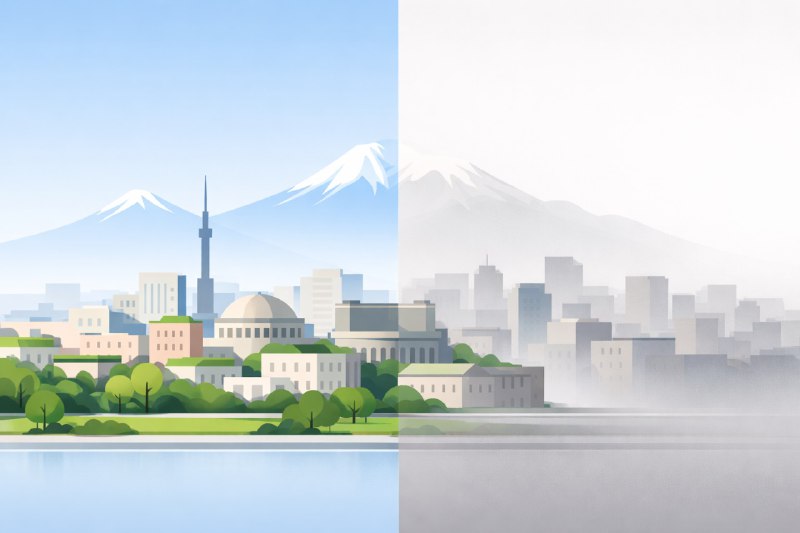
Air quality is a pressing challenge in Armenia’s cities. Rapid urbanization, population growth, and economic development have contributed to worsening air pollution — with significant implications for public health, sustainability, and economic productivity. Understanding how the built environment intersects with air pollution is a vital starting point for effective solutions.
Why Air Pollution Matters in Armenia
Air pollution is linked to respiratory and cardiovascular diseases. In Armenia’s urban centers, particulate pollution frequently exceeds acceptable limits, with the capital Yerevan often recording levels above recommended standards.
According to recent research, cities like Yerevan, Gyumri, and Vanadzor have annual average concentrations of dust and fine particles that often exceed safe levels. Construction activity, transport emissions, industrial operations, and landfill fires are all identified sources of pollution in these environments.
The Armenian government and local authorities have recognized this challenge and are developing long-term strategies to reduce air pollution, including regulatory updates and monitoring improvements.
The Built Environment’s Role in Air Quality
Buildings influence air quality in both direct and indirect ways.
1. Construction Activity and Dust
Construction sites are major localized sources of dust (PM10 and PM2.5) and other airborne particulates. In Yerevan, where construction has accelerated rapidly in recent years, dust and particulate outputs have consistently contributed to poor air quality.
Municipal enforcement around construction dust controls remains uneven, with monitoring devices in place but compliance challenges persisting at many sites.
2. Building Operation and Energy Use
Buildings are among the most significant energy consumers globally. According to international studies, buildings account for up to 40% of total energy-related carbon emissions — a figure likely mirrored in Armenia, given local energy practices.
Energy inefficiencies in buildings — especially older, poorly insulated structures — increase demand for heating and cooling, often supplied by fossil fuels that emit greenhouse gases and particulate pollutants.
3. Lack of Green Infrastructure
Urban green spaces — parks, tree-lined streets, and vegetated surfaces — act as natural “filters” for airborne pollutants. Research in Armenia’s cities shows that native tree species can absorb significant quantities of particulate matter, helping improve air quality when strategically integrated into urban planning.
Yet many Armenian cities lack sufficient vegetative cover. Limited green buffers near construction zones and along trafficked roads reduce the potential for natural pollutant filtration.
Currently, Yerevan has about 7.6–8.3 sq. meters of green space per capita. Meanwhile, the minimum standard set by the World Health Organization (WHO) is 9 sq. meters per capita. Yerevan does not reach even this minimum threshold.
On the other hand, the figure considered ideal by the WHO is 50 sq. meters per capita. For comparison, in Vienna (Austria), there are about 120 sq. meters of green space per capita, including urban forests.
What Is “Green Building” and How Does It Help?
Green building refers to construction practices that minimize environmental impacts over a building’s lifecycle — from design and construction through operation and eventual demolition. Key features include:
- Energy-efficient design that reduces demand for fossil fuels.
- Improved insulation and HVAC systems that cut emissions related to heating and cooling.
- Smart materials and site planning that lower dust emissions during construction.
- Integration of green spaces and urban vegetation that naturally filter air pollutants.
When adopted at scale, green building principles can significantly improve urban air quality, both during construction and throughout a building’s operation:
During the construction phase
- Construction site management, vehicle, and transportation control
Although the construction phase is much shorter than the operational life of a building, it can exert significant pressure on outdoor air quality. Therefore, green buildings have a well-defined construction management plan. This includes erosion and dust control measures, supported by regular and strict site monitoring.
For example, under the LEED standard, an erosion and sedimentation control plan is mandatory. Typical measures include wheel-washing systems for delivery vehicles, regular wetting of construction sites, protection of slopes, and proper management of storage zones. Equally important is the requirement for contractors to provide regular reports on the implementation of these measures, supported by monitoring of air quality, noise levels, and other environmental indicators.
- Biodiversity protection during construction
Protecting existing trees and green areas on construction sites, whenever possible, is critical. The common approach of clearing a site with the intention of restoring landscaping after construction is environmentally harmful. Newly planted or restored landscapes have a much lower capacity to filter air pollutants compared to mature, existing ecosystems.
On the exploitation phase
- Energy- and water-efficient building systems
Green buildings incorporate innovative building envelopes and highly efficient energy and water systems, which significantly reduce resource consumption. These buildings often have longer service lives than conventional buildings, further minimizing negative impacts on air quality by reducing the need for electricity generation and fossil fuel combustion.
- Efficient heating, cooling, and sustainable mobility
Armenia has several climate zones, yet heating and cooling are necessary across the country. As a result, high-efficiency requirements for HVAC equipment, combined with automated control systems, are essential.
Green building standards such as LEED and BREEAM also promote sustainable mobility by encouraging optimization of public transportation, development of bicycle networks, promotion of car sharing, and the use of electric vehicles. Location plays a crucial role in green certification: when essential services (shops, banks, and other amenities) are within walking distance, building occupants are less likely to rely on private transportation. All major green standards emphasize the development of comfortable and accessible public transport to reduce dependence on private cars.
Green Building Progress and Opportunities in Armenia
Armenia is beginning to embrace green construction tools and knowledge sharing. Recent partnerships with international institutions are introducing best practices for energy-efficient building design, insulation solutions, and material selection.
Such guidebooks and advisory materials — developed with UNDP and the World Bank — are intended to support architects, builders, and policymakers in adopting low-emission and climate-resilient construction standards.
Building Toward Cleaner Air — Practical Steps
To strengthen the positive impact of green building on air quality, Armenia can:
1. Improve Construction Dust Controls
Strict enforcement of dust mitigation innovations — such as covering materials and water-spray suppression — reduces airborne particulate matter at building sites. Monitoring and compliance are essential.
2. Expand Urban Green Spaces
Incorporating trees and vegetated barriers near construction zones and traffic corridors can help filter dust and fine particles naturally. Some international concepts for urban development could be implemented, such as ecodistricts and city gardens.
3. Promote Energy-Saving Building Standards
Green building codes that emphasize insulation, passive design, and efficient systems can cut the demand for fossil fuel-based heating and cooling, reducing emissions.
4. Raise Awareness Among Stakeholders
Developers, local governments, and communities all play roles in reducing air pollution — from planning to execution.
Green building standards could be used as a roadmap for national/municipal policies and regulations in the construction and urban planning sector. Green building standards aggregate practical cases and scientific research, and while they are voluntary, they are a base of national regulation, or they are “obligatory” for the public sector.
The development of new urban territories must follow a smart and well-planned approach rather than a chaotic one. Expanding buildable square meters for sale without a sustainable urban vision and green construction principles will not improve air quality; on the contrary, it will worsen it. A strong example of sustainable district development is the concept of ecodistricts, where natural features and ecosystem services—including air quality—are central to territorial planning and design.
Overall, green building and air pollution are tightly linked — especially in rapidly urbanizing settings like Armenia’s cities. By integrating sustainability into design, construction, and urban planning, Armenia can reduce the burden of airborne pollution, enhance public health, and foster environments where people and ecosystems thrive together.
#GreenBuilding #AirQuality #SustainableConstruction #ESG #SustainableCities #GreenGrowthAlliance #EnvironmentalHealth #ClimateResilience #ResponsibleDevelopment #GreenInfrastructure