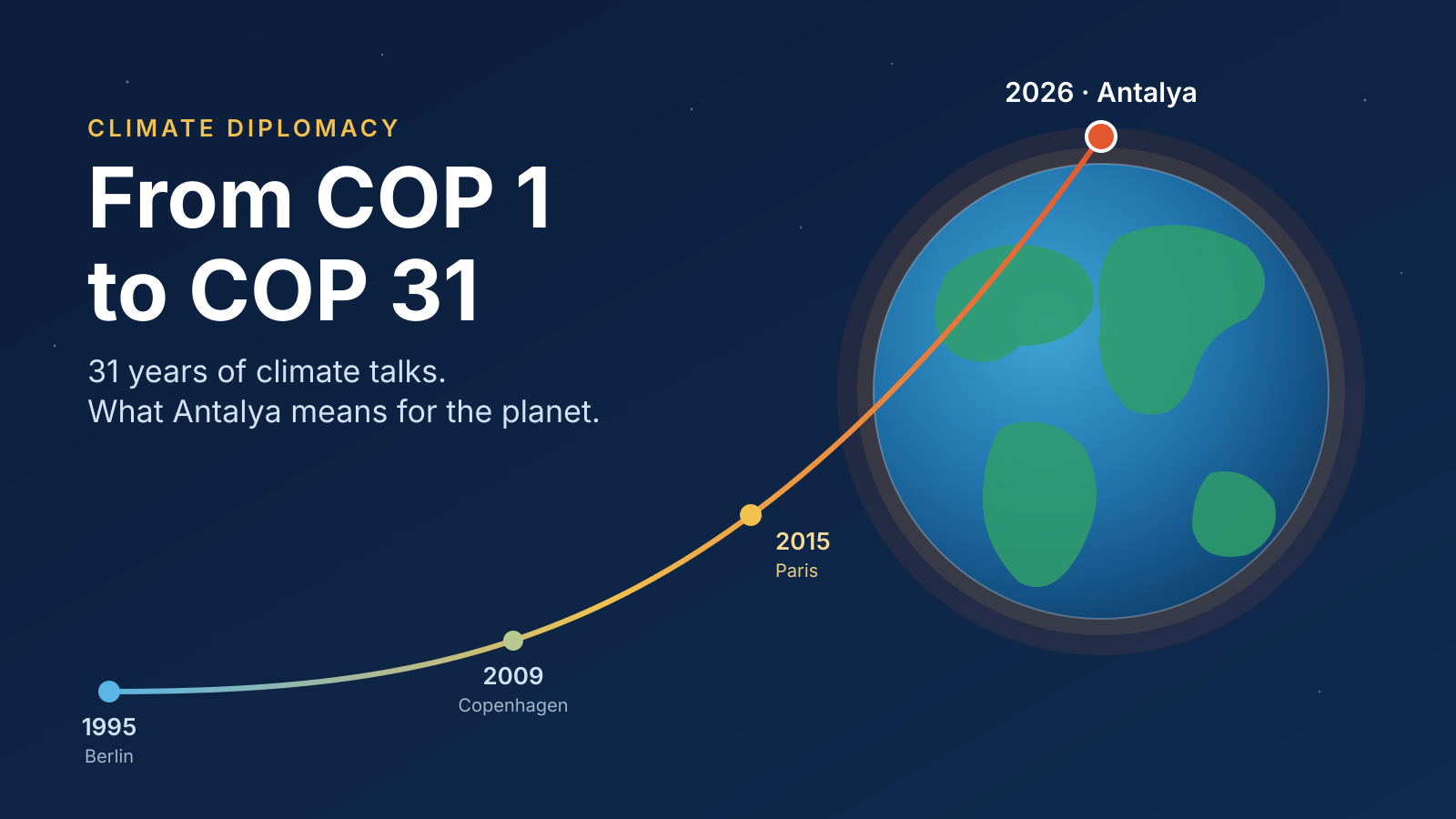
COP 31 in Antalya ended on 22 November 2026 without an overarching political deal: the “Antalya Pact” was rejected because it did not mention fossil fuels. It is the first failure of this kind since Copenhagen in 2009, at the end of the longest climate summit on record. Yet several technical decisions were adopted, on adaptation, just transition, the Adaptation Fund and carbon markets.
The road from COP 1 to COP 31
In thirty-one years, the COPs have moved from targets imposed on a few rich countries to a universal system of national pledges. Each major step added a piece: a temperature goal, a fund, a word on fossil fuels, a finance figure.
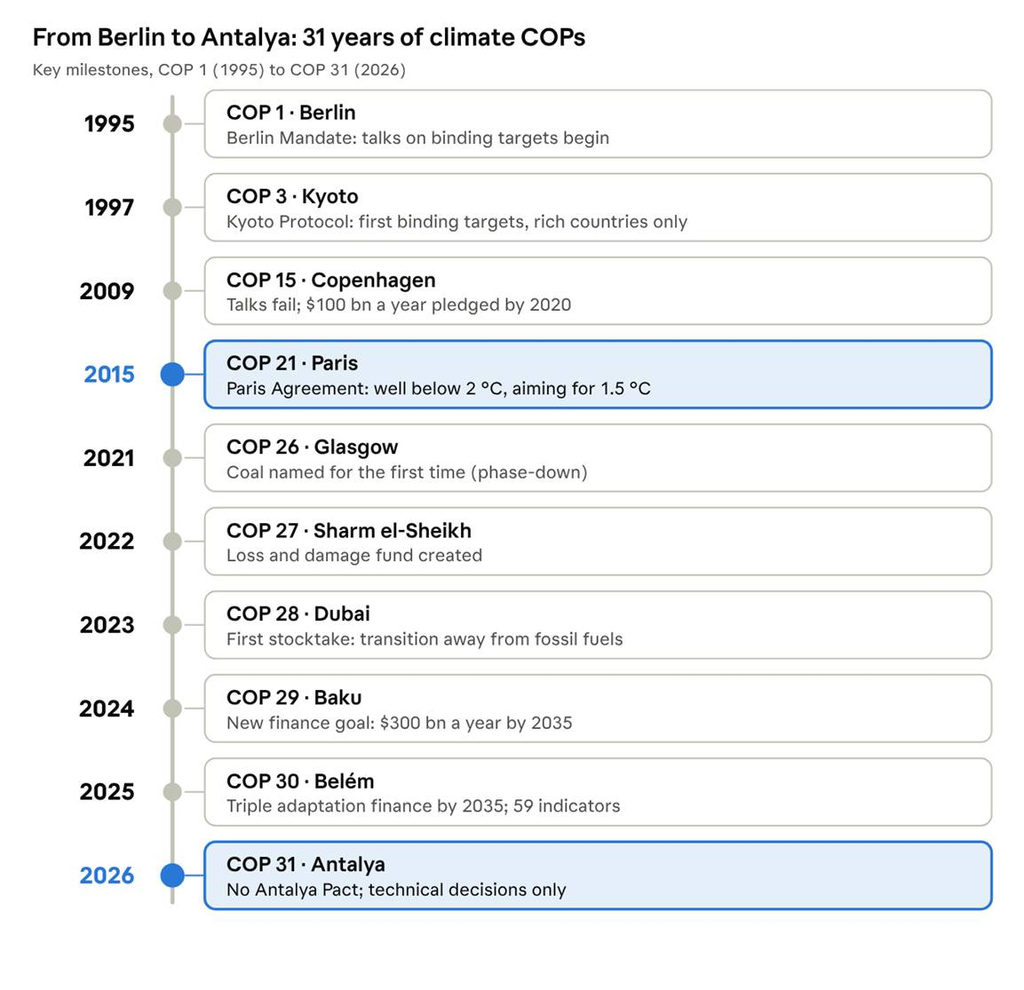
The common thread is clear: since Dubai, fossil fuels have been the political core of the talks. That is exactly where Antalya stalled.
Antalya: why the Pact failed
The draft “Antalya Pact” reaffirmed the 1.5 °C goal but did not explicitly recognise the need to transition away from fossil fuels.
COP 31 President Murat Kurum, Turkey’s environment minister, acknowledged at the closing plenary that there was no consensus, so the text was not adopted. Talks ran two days past the scheduled 20 November close.
Criticism focused on three points:
- Fossil fuels: no mention in the final text, a step back from Dubai.
- Carbon capture: promoted at gigatonne scale by 2035, which critics see as a justification for fossil fuel expansion.
- Loss and damage: no dedicated space and no new pledges.
What was adopted anyway
Without a cover decision, Antalya still leaves several sectoral decisions, adopted on the final day (ENB/IISD).
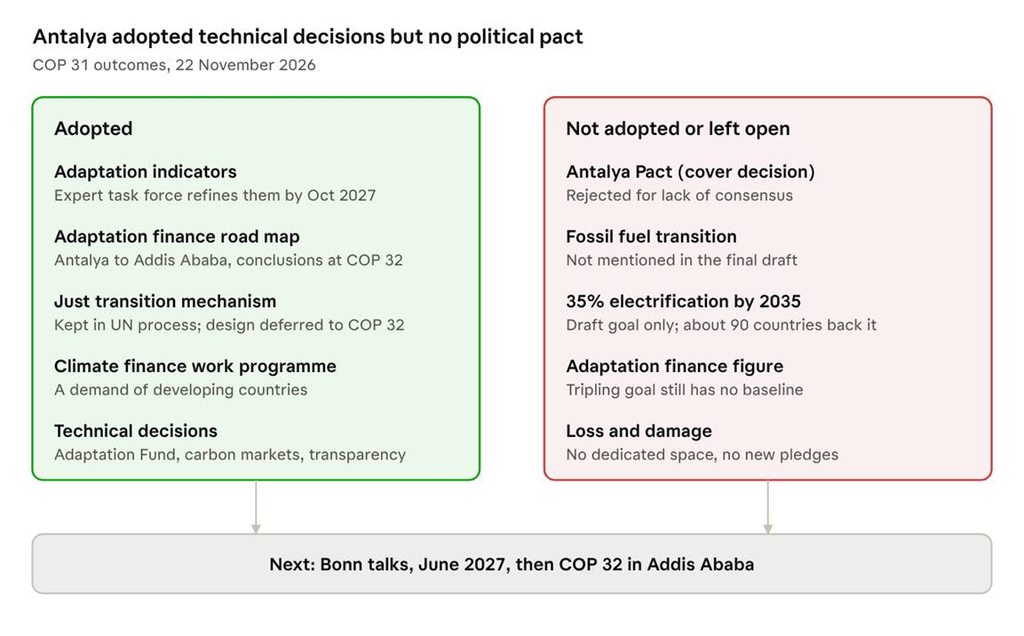
The needs remain huge: developing countries would need $5.1–6.8 trillion through 2030, including about $305 billion a year for adaptation through 2035 (Down To Earth). Down To Earth also reports progress on early-warning systems (universal coverage targeted by 2027) and a two-year work programme on mountains. Because these items were tied to the rejected cover text, their exact status still needs to be confirmed in official UNFCCC documents.
What it means for the planet
Antalya’s central message is alarming: the world is now set to overshoot the Paris Agreement’s 1.5 °C threshold (IISD). Three lessons stand out.
- Fossil fuels remain the fault line. The EU and vulnerable states judged a text that stepped back from Dubai to be worse than no text at all.
- Adaptation is becoming the concrete priority. Indicators, early warning and a finance road map move forward, even without a political deal.
- Action is moving outside the negotiating rooms. Voluntary coalitions, such as the 90 countries behind the electrification goal, along with cities and businesses, are taking over.
The process itself is now in question: dialogues on strengthening consensus-based decision-making are scheduled for November 2027 and 2028.
What’s next: from Bonn to Addis Ababa
Talks resume in Bonn in June 2027, ahead of COP 32 in Addis Ababa, Ethiopia. The issues left open in Antalya will return: the move away from fossil fuels, a figure for adaptation finance, and the structure of the just transition mechanism.
For the South Caucasus, the stakes are twofold. The first is turning Antalya’s technical decisions into real finance for mountain and water resilience. The second is shaping the choice of the COP 34 host, where Yerevan’s bid could make the region a central player in climate diplomacy in 2029.