What LEED and “LEED Earth” actually mean
LEED (Leadership in Energy and Environmental Design) is the rating system developed by the U.S. Green Building Council (USGBC). Buildings earn points across energy, water, materials, indoor environmental quality and site management, and are certified at one of four levels: Certified, Silver, Gold or Platinum. It is not a claim a developer makes about itself but an independent, internationally comparable assessment.
Alongside the core programme, the USGBC runs a campaign called LEED Earth, which recognises the very first project in each developing country to meet LEED’s criteria, a deliberate nudge to open up markets where certified buildings are rare. In June 2017 the USGBC named Armenia among the countries newly eligible for that recognition, setting the stage for the nation’s first LEED project to carry the Earth designation.
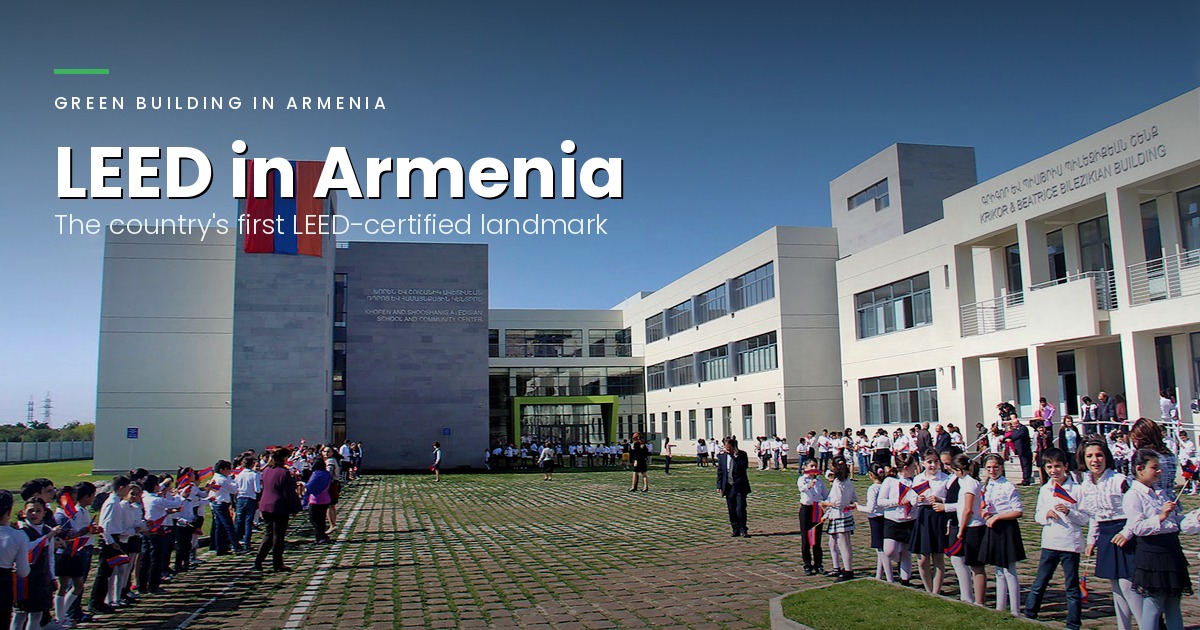
The landmark: the Avedisian School
That project is the Khoren and Shooshanig Avedisian School and Community Center in the Malatia-Sebastia district of Yerevan, operated by the Armenian Missionary Association of America (AMAA). In July 2019 it was awarded LEED Silver, the first building in the Republic of Armenia to achieve LEED certification, and, at the same time, the LEED Earth designation as the country’s inaugural LEED project.
The school itself was established in 1998 through the vision and generosity of benefactors Edward and Pamela Avedisian, but its green credentials belong to the building completed in August 2014: roughly 10,000 square metres of classrooms, two indoor gymnasiums, laboratories and offices, delivered as a working demonstration of what sustainable design could look like in Armenia. The entire building was conceived as an environmental laboratory, integrating rooftop solar, recycled rainwater and green roofs, a natural fit for a country that enjoys well over 300 sunny days a year.
The building was delivered by a local contractor on a roughly 23-month programme, with the LEED application filed in December 2014, and it drew on sustainable-design experience gained earlier at the Paramaz Avedisian Building at the American University of Armenia.
That lineage matters. Pursuing an international standard imposed a discipline on materials, energy performance and construction culture that was, at the time, largely new to the Armenian market, the same discipline that today makes a certified asset legible to ESG-driven lenders and investors. In a seismically active country, designing to an international benchmark tends to travel alongside a broader commitment to build quality and resilience.