
Sustainability in real estate was long treated as a reputational add-on, a line in the annual report, a certification plaque in the lobby, a talking point for the ESG team. That framing is now obsolete. Buildings account for roughly 40% of global energy-related emissions, and the regulatory, financial and tenant pressures bearing down on the sector have turned a company’s sustainability approach into a direct driver of rental income, asset value and cost of capital.
For anyone allocating money to property (through listed REIT shares, private real estate funds, or direct ownership) the way a company handles sustainability is no longer a soft consideration. It has become one of the clearest available signals of how well management is protecting, and growing, the value of the underlying assets. Here is why it belongs at the centre of investment analysis rather than the margins.
The green premium: sustainability as value creation
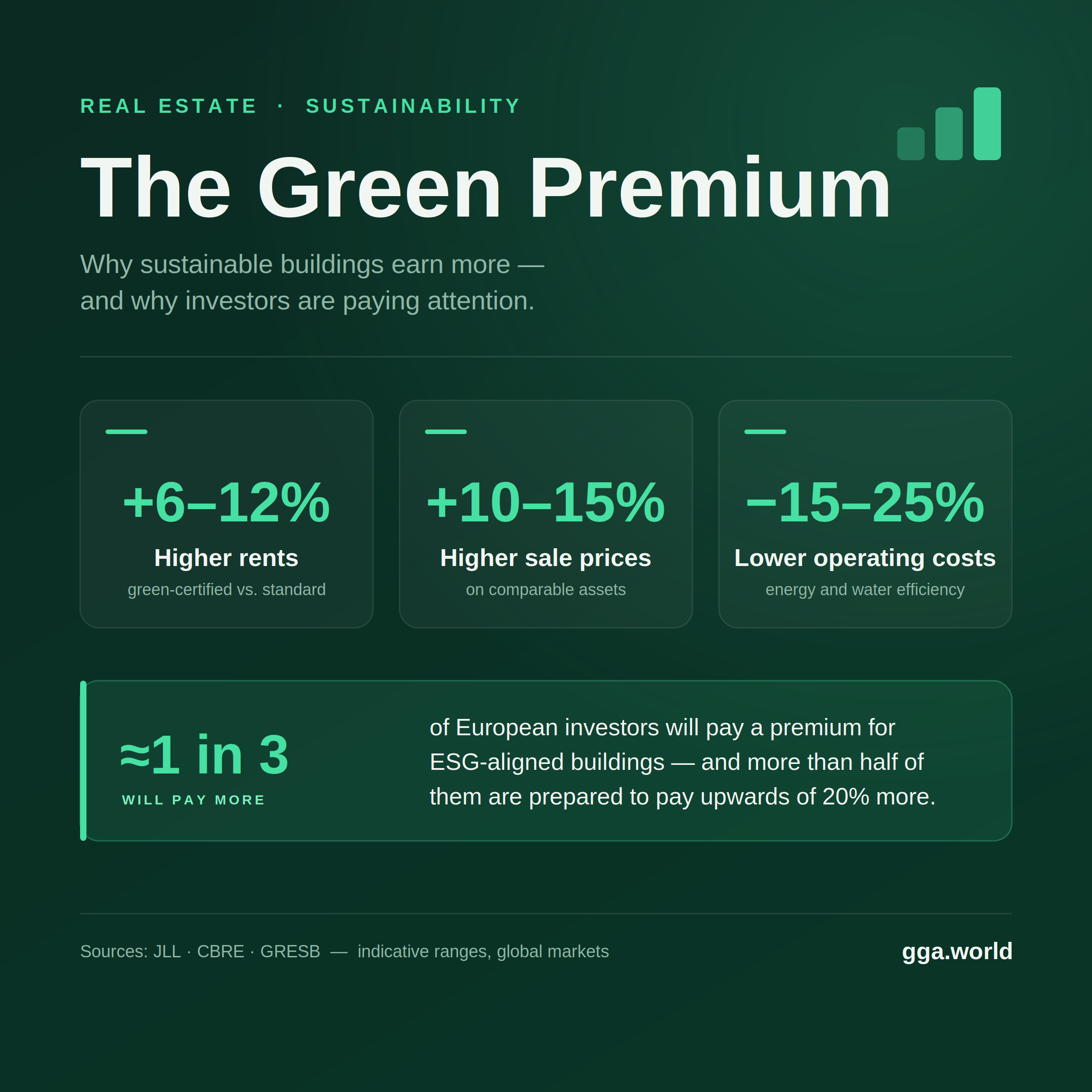
The most direct reason sustainability matters is that green buildings simply earn more. Multiple independent studies now point in the same direction. JLL research has identified rental premiums in the range of roughly 7% to 12% for green-certified office assets across global markets. CBRE has reported that certified buildings tend to command rents around 6% to 10% higher and sell for roughly 10% to 15% more than comparable non-certified properties, alongside higher occupancy and materially lower operating costs.
Those operating-cost savings often 15% to 25% lower for energy- and water-efficient stock flow straight through to net operating income, which is what ultimately drives valuation. A building that is cheaper to run, easier to let and commands a rent premium is worth more on almost any metric an investor uses.
Cost of capital and access to financing
Sustainability performance now shapes not just what a building earns, but how cheaply its owner can borrow. Lenders are tightening criteria for energy-inefficient buildings, and green loan and green bond frameworks increasingly exclude assets that fail to meet minimum energy thresholds. Conversely, high-quality sustainability data helps owners qualify for green financing and secure better loan terms and lower borrowing costs.
Institutional capital is moving the same way. A CBRE study cited by GRESB found that roughly a third of European investors were willing to pay a premium for ESG-aligned buildings, with more than half of those prepared to pay in excess of 20%. When a meaningful share of the buyer pool will pay up for sustainability a company’s approach feeds directly into both its exit values and its financing costs.
GRESB: the benchmark investors rely on
The market has built infrastructure specifically to price all of this, and its centre of gravity is the Global ESG Benchmark for Real Assets (GRESB). GRESB is an investor-led organisation that collects, validates and scores standardised sustainability data from listed property companies, private funds, developers and direct investors, then benchmarks each participant against its peers. The assessment spans energy and water use, greenhouse gas emissions, waste, tenant engagement, health and safety, and governance, scored across management, performance and development components, and aligned with established reporting frameworks. In its 2025 cycle, more than a thousand fund managers submitted over 2,300 assessments, covering thousands of funds and portfolios worldwide.
What makes GRESB matter to investors is less the questionnaire than the audience. Pension funds, sovereign wealth funds and insurers increasingly fold GRESB scores into due diligence, benchmarking and capital-allocation decisions, and many of the world’s largest asset owners now ask their managers to participate as a condition of doing business. That turns the benchmark into a feedback loop: a strong, improving score widens access to capital, while non-participation is increasingly read as a competitive weakness. For an investor, a company’s GRESB trajectory is a compact, independently validated read on whether its sustainability approach is real and getting better.
How investors read the approach as a signal
Beyond any single benchmark, a sustainability approach matters because it functions as a proxy for management quality. A company that captures granular, verified performance data, sets credible targets and plans its retrofit spending ahead of the regulatory curve is demonstrating exactly the kind of long-term, forward-looking asset stewardship investors are paying for. A company that cannot produce that data is telling you something too.
The bottom line
A real estate company’s sustainability approach is no longer a values statement sitting apart from the financials, it is woven through them. On the downside, it determines exposure to stranded-asset risk, regulatory cost and a rising cost of capital. On the upside, it drives rental premiums, tenant demand, occupancy and access to cheaper financing. And as a signal, it reveals how competently management is steering the portfolio through a structural shift that is already repricing the entire sector.
For investors, that makes sustainability analysis inseparable from ordinary financial due diligence. The companies that treat it as core strategy are managing risk and creating value at the same time; the ones that treat it as an afterthought are quietly accumulating liabilities that the market is increasingly willing to price in.